
AI agents are quickly moving from experiment to execution across Australian enterprises.
That makes the Salesforce Agentic Enterprise Index 2026 particularly timely. The second edition tracks how organisations using Agentforce and other Salesforce products are deploying AI agents, how quickly those agents are scaling, and the kind of work they are beginning to handle. The underlying analysis covers businesses consistently using agents between February 2025 and April 2026.
For Australian businesses, though, the Index tells only part of the story.
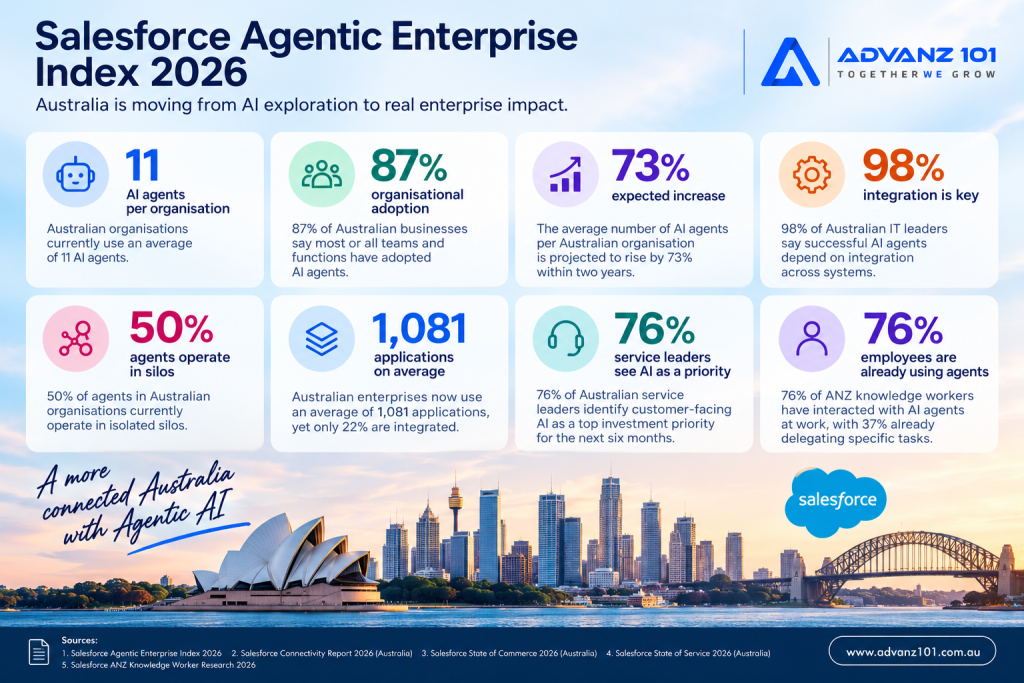
Local Salesforce research shows that Australian organisations are already using an average of 11 AI agents, with that number projected to rise 73% within two years. Meanwhile, 87% say most or all teams and functions have already adopted AI agents in Australia.
So the conversation in Australia is changing. It is becoming less about whether businesses should use AI agents and more about how to make them useful, connected and governable at enterprise scale.
AI Agents in Australia Are Moving From Pilots to Production
One of the clearest findings from the Salesforce Agentic Enterprise Index is the speed of adoption.
Across the businesses studied, the average number of activated agents grew from 5 in February 2025 to 13 by April 2026, nearly tripling. At the same time, the average time needed to create an agent dropped by 53%.
Australia is seeing a similar move towards execution.
At Agentforce World Tour Sydney, Salesforce described the local AI conversation as shifting from “what if” to “how fast,” with Australian organisations increasingly looking at how people, data and agents can operate together.
For organisations considering Agentforce in Australia, that shift matters. A successful deployment is no longer simply about creating an impressive proof of concept. Businesses need to decide which workflows are worth automating, what data an agent can access and when a human needs to remain involved.
Australian Businesses Are Scaling Agentic AI
Commerce provides a useful snapshot of where the Australian market is heading.
Salesforce research released in August found that 24% of Australian commerce organisations currently use agentic AI, while 54% of non-adopters plan to deploy it within the next six months. Among organisations already using the technology, only 6% remain primarily focused on pilots, while 24% are prioritising scaling it across teams and functions.
Customer service is another area moving quickly.
More than three-quarters (76%) of Australian service leaders identify customer-facing AI as a top investment priority for the next six months. That compares with a global figure of 61%.
The implication is fairly straightforward. AI adoption in Australian enterprises is moving beyond isolated innovation teams and into functions that directly affect customers, employees and revenue.
Agents Are Starting to Do Real Work
One of the most useful ideas in the 2026 Index is the distinction between AI that generates something and AI that actually completes work.
Salesforce measures this through Agentic Work Units (AWUs). An AWU represents a discrete task performed by an agent, such as processing a prompt, completing a reasoning chain or invoking a tool.
By April 2026, the businesses analysed in the Index had generated 734 million AWUs, while the Action-to-Output ratio was growing at a 15% compound monthly rate.
Why does that matter?
An AI assistant that summarises customer conversations can save time. An agent that understands the conversation, accesses the correct Salesforce record, applies approved business rules and initiates the next workflow starts to change how work gets done.
For Australian organisations investing in Salesforce AI and Agentforce, that is where the bigger opportunity lies.
AI Agents Are Becoming More Capable
Agents aren’t just becoming more common. They are becoming more versatile.
The Index found that the average number of unique skills available to an agent increased from two to six during 2025. In retail, agents expanded to an average of nine skills during peak periods, representing a 350% increase in capability compared with normal periods.
That flexibility could be valuable across several major Australian industries.
A retailer might use agents for customer enquiries, product discovery and order support. A financial institution could focus on tightly governed service workflows. Healthcare organisations may prioritise administrative tasks and patient or member engagement. Manufacturers could look at service, sales and operational processes.
The use cases differ. The underlying requirement doesn’t: trusted data and clearly defined processes.
Integration Could Be Australia’s Bigger Challenge
This is where the Australian data becomes particularly interesting.
Despite rapid AI adoption, 50% of agents in Australian organisations currently operate in isolated silos rather than as part of a multi-agent system. Salesforce also found that Australian enterprises now use an average of 1,081 applications, yet only 22% are integrated.
That creates a problem.
An AI agent can only be as useful as the systems, data and business processes it can securely work with. Adding more agents to fragmented technology environments risks creating another layer of complexity.
Australian IT leaders recognise the issue. 98% say agent success depends on integration across systems, while 96% are concerned that agents could introduce more complexity than value.
For Salesforce organisations, integration, data quality and governance therefore become central to any serious Agentforce Australia implementation strategy.
Trust and Human Accountability Still Matter
Australian employees are already becoming comfortable working alongside agents.
Research covering Australia and New Zealand found that 76% of knowledge workers have interacted with AI agents at work, while 37% already delegate specific tasks for agents to handle independently.
But adoption doesn’t eliminate concern.
The same research found that 38% of ANZ knowledge workers identified a lack of accountability for AI mistakes as their biggest concern about autonomous AI.
This is an important reminder for Australian enterprises.
The goal shouldn’t be automation at any cost. Organisations need permissions, escalation paths, data controls and human oversight designed into the agent from the start.
From Agentic AI Adoption to Enterprise Value
The Salesforce Agentic Enterprise Index 2026 points to a broader change in enterprise AI Australia: agents are becoming faster to deploy, more capable and increasingly responsible for completing work rather than simply generating content.
Australia appears well into that transition.
The opportunity now is to make sure Salesforce AI agents in Australia are connected to the right data, governed appropriately and deployed against processes where they can produce measurable value.
At Advanz101, we help Australian businesses translate that opportunity into practical Salesforce solutions. From Agentforce implementation and Salesforce consulting in Australia to integration, Data Cloud and industry-specific solutions, our focus is on connecting AI agents with the processes, data and people that make an enterprise work.
Because becoming an Agentic Enterprise isn’t about having the most agents – it’s about making them useful.