
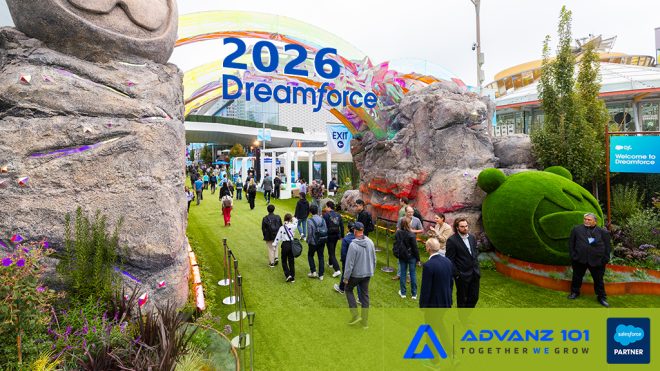
Dreamforce 2026 has wrapped up in San Francisco, and Salesforce’s direction is clearer than ever.
From September 15–17, the conversation moved beyond adding AI to CRM. Salesforce laid out a much broader vision for the Agentic Enterprise, where people, AI agents, applications, data and business processes work together across the enterprise.
For Australian businesses already running Salesforce, several announcements deserve attention. AIforce, Koa, deeper hyperscaler partnerships and the continued expansion of Agentforce all point towards a Salesforce environment that is becoming more open, intelligent and less tied to a traditional CRM interface.
Here’s our Dreamforce 2026 lowdown, and what it could mean for Salesforce organisations in Australia.
AIforce Takes Salesforce Beyond the Traditional CRM Interface
The headline announcement was AIforce.
Salesforce describes AIforce as a new live interface layer that can bring Salesforce data, workflows, business logic, permissions, security and governance into the interfaces where people and AI agents actually work. Rather than requiring every interaction to happen inside a conventional Salesforce screen, AIforce is designed to make Salesforce capabilities available across other AI and productivity environments.
Think of it as Salesforce becoming less about where you work and more about providing the trusted business context behind how work gets done.
That has interesting implications for Australian enterprises managing complex technology estates. Existing Salesforce investments in data models, Flows, Apex, permissions and business processes potentially become more valuable when they can support experiences beyond the Salesforce UI.
Meet Koa, Salesforce’s First CRM Reasoning Model
Salesforce and NVIDIA also announced Koa, Salesforce’s first reasoning model specifically built for CRM.
Built on NVIDIA Nemotron, Koa has been developed to reason through complex, multi-step enterprise tasks. Salesforce says it was trained using synthetic scenarios reflecting nearly three decades of CRM knowledge, with no customer data used to train the model.
This is an important distinction.
General-purpose AI models know a lot. Koa is being designed to understand how CRM work happens, including activities such as qualifying opportunities, updating records, routing service cases and determining the next action within a workflow.
For sectors such as Australian financial services, healthcare and manufacturing, the combination of specialised reasoning and stronger controls around data and inference could be particularly relevant. Availability, however, needs watching: Salesforce currently says general availability for Koa is expected in winter 2026 in US regions, so Australian organisations should verify regional availability before planning deployment.
Salesforce Deepens Its Partnerships With AWS and Google Cloud
Dreamforce also showed that Salesforce’s AI strategy is becoming increasingly model- and cloud-flexible.
The expanded AWS partnership brings Salesforce business context into Amazon Quick, AWS agents into Slack and a broader range of Amazon Bedrock models into Agentforce. Data 360 zero-copy access is also expanding across additional AWS services, while Agentforce Voice and Amazon Connect Customer are being connected through Agent2Agent support.
The Google Cloud partnership follows a similar direction. Salesforce’s headless architecture is being connected with Gemini Enterprise so agents across the two platforms can reason and act using shared business context. Salesforce is also bringing Hyperforce workloads to Google Cloud, although the initial customer migration announced for Q4 2026 applies to select US customers.
For Australian CIOs, the bigger story is choice. Salesforce is building an ecosystem where enterprises can potentially combine their CRM with different models, clouds, data platforms and workplace interfaces rather than committing every AI workload to a single stack.
Agentforce Moves Further Into Real Business Operations
If earlier Dreamforce events introduced the idea of AI agents, 2026 was much more about putting them to work.
One example came from Live Nation. Its Venue Agent uses Agentforce to provide answers across 120 venue websites and has the potential to automate more than 300,000 fan enquiries annually.
Adecco Group also announced an Agentforce Coworker rollout spanning 40 countries, while Siemens highlighted its use of Agentforce in industrial sales and service. These examples reinforce a key theme from this year’s event: agents are moving into customer service, employee workflows, sales and operational processes at enterprise scale.
Salesforce’s recent Agentic Enterprise Index supports that direction. The average number of activated agents per organisation has increased nearly threefold over the past year, while businesses are now beginning to create agents within an average of around two days after provisioning.
Missionforce Signals More AI for Government and Regulated Industries
Public sector organisations also received significant attention.
Salesforce expanded Missionforce with purpose-built AI and announced work with OpenAI and NVIDIA around mission intelligence. The focus is on bringing AI into complex government operations while addressing the security, deployment and data-control requirements associated with sensitive environments.
For Australia, the immediate product availability and regulatory context will differ from the US. But the direction is relevant to government agencies and highly regulated organisations considering where AI can safely participate in operational workflows.
What Dreamforce 2026 Means for Australian Salesforce Organisations
For Australian businesses, Dreamforce 2026 wasn’t simply another collection of AI announcements.
The larger change is architectural.
Salesforce is moving towards a world where your CRM data and business logic can support agents working across Salesforce, Slack and external AI environments. At the same time, specialised models such as Koa are being built to reason about enterprise workflows rather than simply generate answers.
That makes data readiness, governance and process design more important, not less. Before asking how many agents to deploy, Australian organisations should be asking whether their Salesforce data is reliable, whether permissions accurately reflect the business, which processes are suitable for agent-driven execution and where human oversight needs to remain.
From Dreamforce to Enterprise Outcomes with Advanz101
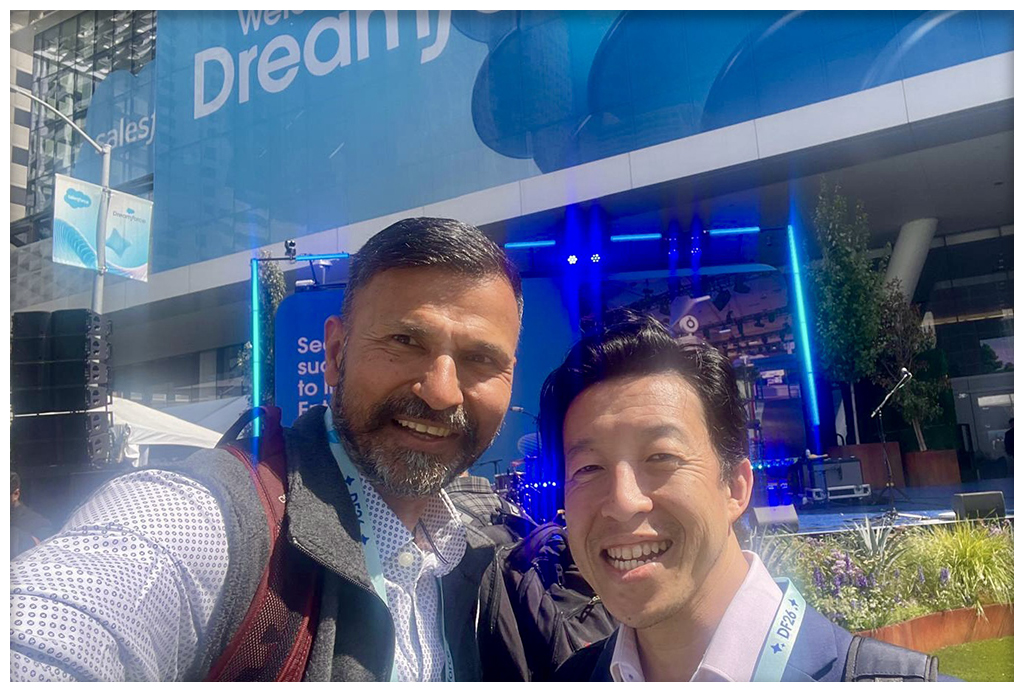
Sumeet Vyas (L) President and Co-founder of Advanz101, with Bryan Tan, Chief Health Officer at Salesforce.
Being at Dreamforce gives the Advanz101 team an opportunity to see these developments firsthand and, more importantly, consider how they translate into practical outcomes for our clients.
For Australian businesses, becoming an Agentic Enterprise isn’t about adopting every announcement from Dreamforce. It is about identifying the Salesforce capabilities that fit your organisation, connecting the right data and workflows, and introducing AI where it can produce measurable value.
Advanz101 works with Australia-based businesses to do exactly that. From Salesforce consulting and implementation to Agentforce, industry solutions, integrations and ongoing optimisation, we help organisations connect Salesforce technology with their broader enterprise goals.
Dreamforce 2026 gave us plenty of new technology to think about. The next step is turning it into something that works for your business.